

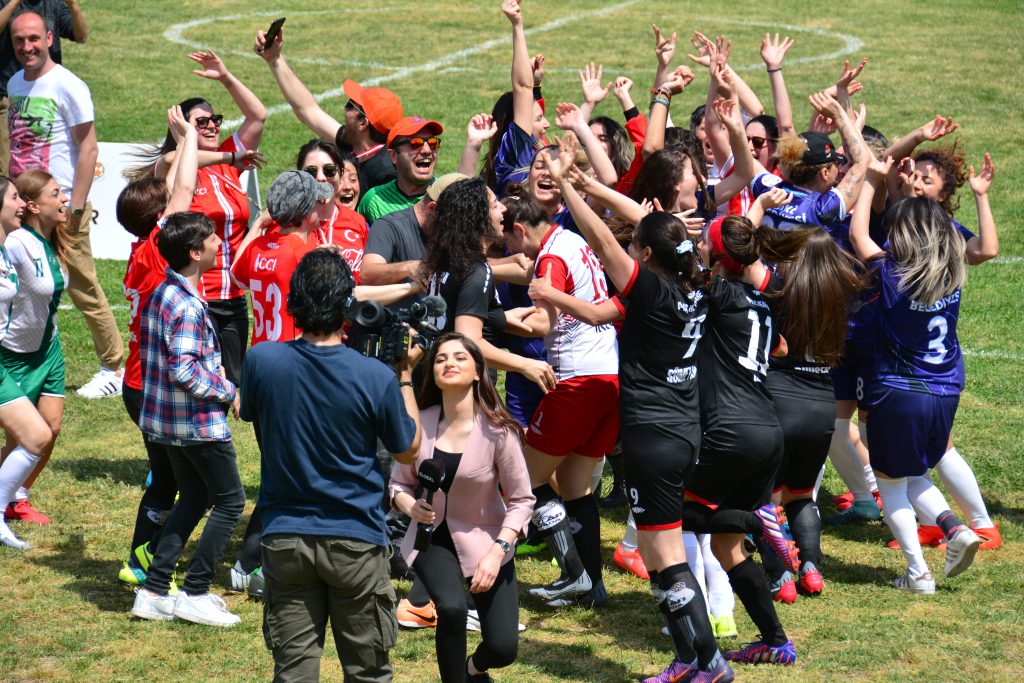
SUMMARY: KIZLAR SAHADA (Women on the Field)
In this chapter of the Refugee Sports Profile: we highlight Kizlar Sahada. Kizlar Sahada is based across Türkiye and uses football for development, developing programmes mainly targeting girls from age 9 to 18 to have access to sports at the grassroots level. They do not mainly target refugees but ensure that all sessions are accessible. They also design projects for female football players off the pitch by developing their soft skills and technical skills, such as sport nutrition, sport physiotherapy, sport psychology, and management skills.
CHALLENGES
Kizlar Sahada provides these skills to female footballers as part of a dual career and economic empowerment approach. Kizlar Sahada’s greatest challenge remains restrictive gender roles. These imply that women and girls should not play football or when they do they are not recognised- making them invisible. These beliefs affect both individuals and institutions. Gender roles and what a women should do or not do are discussed everywhere in families, schools and municipalities and because of that a specific sport program based on women and girls needs was launched, no matter the challenges.
Another challenge is the Lack of facilities, as football is the most popular sport in Türkiye, which makes it hard for women and girls to find spaces to play football. Even if there is a facility, other challenges start such as accessibility, the mindset of families and society where women and girls playing football is seen as a waste of time. Lack of institutional support, people in power with access to resources seldom invest in projects for women and girls. Most sports have been socially stratified along economic lines, with football seen as a lower class of sport compared to tennis, horse-riding, and swimming. This further reduces the appeal to some families.

LESSONS LEARNED
To overcome these challenges Kizlar Sahada implements Family seminars and uses terminology that is understandable in the local context like “child development” rather than gender rights. Kizlar Sahada used to distribute all equipment, human resources and financial resources equally to all clubs, however, they learned it is important to distribute all resources according to the needs of these clubs (equity over equality).
Kizlar Sahada’s approach changed from distributing all the resources to clubs equally to distributing the resources according to a club’s needs. Role models involvement is really important as they motivate and encourage participants and also families, however these celebrities should be aware of the project’s vision and how football can be used to reach the project’s aims. For that, Kizlar Sahada tries to educate the role model before they work with them.
Raising gender sensitive issues is difficult but important. Kizlar Sahada educates clubs and institutions to create safe spaces for women in football. Clubs now approach Kizlar Sahada to help them on how to deal with different gender sensitive issues.
IMPACT
For each project Kizlar Sahada focuses on specific social impact and competencies, the competencies change according to the dynamics of the group and the design of the new projects. Kizlar Sahada focuses on measuring the social impact of their work through their SROI (Social Return on investment) reports. The organisation is working on achieving broader impacts such as self-awareness, self-confidence, motivation to play football, psychological stamina, and social abilities.
They also focus on Impact quality over quantity, Kizlar Sahada focuses on the quality of trainings and projects for girls and women rather than reaching bigger numbers without changing the background and addressing the challenges these participants face such as gender equality, inclusivity and how to practically achieve these goals on the ground.
Refugee Sports Profile: Kizlar Sahada. For more on refugee sports programming and how to create inclusive, impactful and sustainable projects please contact info@thesportseffect.org